
ISSN :1674-2370
CN :32-1785/TV
| Citation: | Pei-pei Zhang, Yi-qing Gong, Ken Vui Chua, Jie Dai, Jing-qiao Mao. 2024: Numerical study of submerged bending vegetation under unidirectional flow. Water Science and Engineering, 17(1): 92-100. doi: 10.1016/j.wse.2023.06.001

|
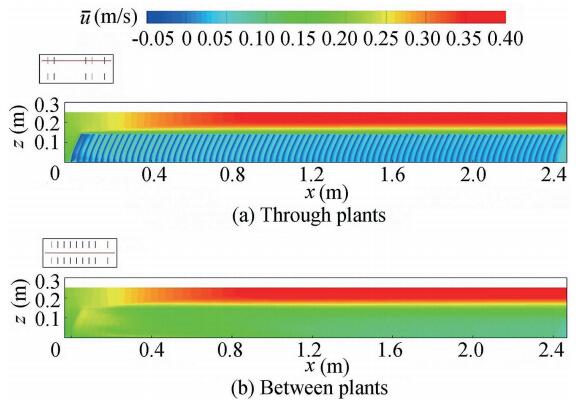
Submerged vegetation commonly grows and plays a vital role in aquatic ecosystems, but it is also regarded as a barrier to the passing flow. Numerical simulations of flow through and over submerged vegetation were carried out to investigate the effect of vegetation density on flow field. Numerical simulations were computationally set up to replicate flume experiments, in which vegetation was mimicked with flexible plastic strips. The fluid–structure interaction between flow and flexible vegetation was solved by coupling the two modules of the COMSOL packages. Two cases with different vegetation densities were simulated, and the results were successfully validated against the experimental data. The contours of the simulated time-averaged streamwise velocity and Reynolds stress were extracted to highlight the differences in mean and turbulent flow statistics. The turbulence intensity was found to be more sensitive to vegetation density than the time-averaged velocity. The developing length increased with the spacing between plants. The snapshots of the bending vegetation under instantaneous velocity and vorticity revealed that flexible vegetation responded to the effects of eddies in the shear layer by swaying periodically. The first two rows of vegetation suffered stronger approaching flow and were prone to more streamlined postures. In addition, the origin of tip vortices was investigated via the distribution of vorticity. The results reveal the variation of flow properties with bending submerged vegetation and provide useful reference for optimization of restoration projects.

|
Ackerman, J., Okubo, A., 1993. Reduced mixing in a marine macrophyte canopy. Functional Ecology 7(3), 305-309. https://doi.org/10.2307/2390209.
|
|
Anjum, N., Tanaka, N., 2019. Numerical investigation of velocity distribution of turbulent flow through vertically double-layered vegetation. Water Science and Engineering 12(4), 319-329. https://doi.org/10.1016/j.wse.2019.11.001.
|
|
Baghel, R., Kalla, S., Upadhyaya, S., Chaurasia, S., Singh, K., 2020. CFD modeling of vacuum membrane distillation for removal of Naphthol blue black dye from aqueous solution using COMSOL multiphysics. Chemical Engineering Research and Design 158, 77-88. https://doi.org/10.1016/j.cherd.2020.03.016.
|
|
Chen, H., Zou, Q.P., 2019. Eulerian-Lagrangian flow-vegetation interaction model using immersed boundary method and OpenFOAM. Advances in Water Resources 126, 176-192. https://doi.org/10.1016/j.advwatres.2019.02.006.
|
|
Defina, A., Bixio, A.C., 2005. Mean flow and turbulence in vegetated open channel flow. Water Resources Research 41(7), W07006. https://doi.org/10.1029/2004WR003475.
|
|
Fischer-Antze, T., Stoesser, T., Bates, P., Olsen, N.R.B., 2001. 3D numerical modelling of open-channel flow with submerged vegetation. Journal of Hydraulic Research 39(3), 303-310. https://doi.org/10.1080/00221680109499833.
|
|
Ghisalberti, M., Nepf, H., 2004. The limited growth of vegetated shear layers. Water Resources Research 40(7), W07502. https://doi.org/10.1029/2003WR002776.
|
|
Ghisalberti, M., Nepf, H., 2005. Mass transport in vegetated shear flows. Environmental Fluid Mechanics 5, 527-551. https://doi.org/10.1007/s10652-005-0419-1.
|
|
Gong, Y., Stoesser, T., Mao, J., McSherry, R., 2019. LES of flow through and around a finite patch of thin plants. Water Resources Research 55(9), 7587-7605. https://doi.org/10.1029/2018WR023462.
|
|
Hashiguchi, M., 2012. Possibility of Implicit LES for Two-Dimensional Incompressible Lid-Driven Cavity Flow Based on COMSOL Multiphysics. COMSOL, Stockholm. https://www.comsol.it/paper/download/159355/hashiguchi_paper.pdf.
|
|
Houda, S., Belarbi, R., Zemmouri, N., 2017. A CFD Comsol model for simulating complex urban flow. Energy Procedia 139, 373-378. https://doi.org/10.1016/j.egypro.2017.11.224.
|
|
Huai, W., Zhang J., Katul, G.G., Cheng, Y., Tang, X., Wang, W., 2019. The structure of turbulent flow through submerged flexible vegetation. Journal of Hydrodynamics 31(2), 274-292. https://doi.org/10.1007/s42241-019-0023-3.
|
|
Kosten, S., Lacerot, G., Jeppesen, E., Marques, D.M., Mazzeo, N., Scheffer, M., Nes, E.H., 2009. Effects of submerged vegetation on water clarity across climates. Ecosystems 12(7), 1117-1129. https://doi.org/10.1007/s10021-009-9277-x.
|
|
Kutija, V., Hong, H.T.M., 1996. A numerical model for assessing the additional resistance to flow introduced by flexible vegetation. Journal of Hydraulic Research 34(1), 99-114. https://doi.org/10.1080/00221689609498766.
|
|
Liu, D., Diplas, P., Fairbanks, J.D., Hodges, C.C., 2008. An experimental study of flow through rigid vegetation. Journal of Geophysical Research: Earth Surface 113(F4), F04015. https://doi.org/10.1029/2008JF001042.
|
|
Lopez, F., Garcia, M., 2001. Mean flow and turbulence structure of open-channel flow through non-emergent vegetation. Journal of Hydraulic Engineering 127, 392-402. https://doi.org/10.1061/(ASCE)0733-9429(2001)127:5(392).
|
|
Luhar, M., Nepf, H.M., 2011. Flow-induced reconfiguration of buoyant and flexible aquatic vegetation. Limnology and Oceanography 56(6), 2003-2017. https://doi.org/10.4319/lo.2011.56.6.2003.
|
|
Malaeb, R., Mahfoud, E., Harb, M., 2018. Decomposition of fundamental lamb wave modes in complex metal structures using COMSOL. In: Proceedings of the 2018 COMSOL Conference in Lausanne. COMSOL, Lausanne.
|
|
Marjoribanks, T.I., Hardy, R.J., Lane, S.N., Parsons, D.R., 2014. High-resolution numerical modelling of flow-vegetation interactions. Journal of Hydraulic Research 52, 775-793. https://doi.org/10.1080/00221686.2014.948502.
|
|
Neary, V.S., 2003. Numerical solution of fully developed flow with vegetative resistance. Journal of Engineering Mechanics 129(5), 558-563. https://doi.org/10.1061/(ASCE)0733-9399(2003)129:5(558).
|
|
Nepf, H.M., Vivoni, E.R., 2000. Flow structure in depth-limited, vegetated flow. Journal of Geophysical Research: Oceans 105(C12), 28547-28557. https://doi.org/10.1029/2000JC900145.
|
|
Nepf, H.M., Ghisalberti, M., 2008. Flow and transport in channels with submerged vegetation. Acta Geophysica 56(3), 753-777. https://doi.org/10.2478/s11600-008-0017-y.
|
|
Nicholas, A.R., McLelland, S.J., 2004. Computational fluid dynamics modelling of three-dimensional processes on natural river floodplains. Journal of Hydraulic Research 42(2), 131-143. https://doi.org/10.1080/00221686.2004.9728377.
|
|
Nikora, V., 2010. Hydrodynamics of aquatic ecosystems: an interface between ecology, biomechanics and environmental fluid mechanics. River Research and Applications 26(4), 367-384. https://doi.org/10.1002/rra.1291.
|
|
Okamoto, T., Nezu, I., Sanjou, M., 2016. Flow-vegetation interactions: Length-scale of the “monami” phenomenon. Journal of Hydraulic Research 54(3), 251-262. https://doi.org/10.1080/00221686.2016.1146803.
|
|
Pu, J.H., Hussain, A., Guo, Y., Vardakastanis, N., Hanmaiahgari, P.R., Lam, D., 2019. Submerged flexible vegetation impact on open channel flow velocity distribution: An analytical modelling study on drag and friction. Water Science and Engineering, 12(2), 121-128. https://doi.org/10.1016/j.wse.2019.06.003.
|
|
Siniscalchi, F., Nikora, V.I., Aberle, J., 2012. Plant patch hydrodynamics in streams: Mean flow, turbulence, and drag forces. Water Resources Research 48(1), W01513. https://doi.org/10.1029/2011WR011050.
|
|
Stoesser, T., Salvador, G.P., Rodi, W., Diplas, P., 2009. Large eddy simulation of turbulent flow through submerged vegetation. Transport in Porous Media 78(3), 347-365. https://doi.org/10.1007/s11242-009-9371-8.
|
|
Stoesser, T., Kim, S.J., Diplas, P., 2010. Turbulent flow through idealized emergent vegetation. Journal of Hydraulic Engineering 136(12), 1003-1017. https://doi.org/10.1061/(ASCE)HY.1943-7900.0000153.
|
|
Sun, M.L., Wu, D., Wang, M.Q., Jin, S.F., Wang, K.Z., 2011. Simulation analysis of fluid-structure interactions with moving mesh. Advanced Materials Research 305, 235-238. https://doi.org/10.4028/www.scientific.net/AMR.305.235.
|
|
Taddeo, S., Dronova, I., 2018. Indicators of vegetation development in restored wetlands. Ecological Indicators 94, 454-467. https://doi.org/10.1016/j.ecolind.2018.07.010.
|
|
Tanino, Y., Nepf, H.M., 2008. Lateral dispersion in random cylinder arrays at high Reynolds number. Journal of Fluid Mechanics 600, 339-371. https://doi.org/10.1017/S0022112008000505.
|
|
Vance, C.P., 2001. Symbiotic nitrogen fixation and phosphorus acquisition. Plant nutrition in a world of declining renewable resources. Plant Physiology 127(2), 390-397. https://doi.org/10.1104/pp.010331.
|
|
Villalobos-Lara, A.D., Perez, T., Uribe, A.R., Alfaro-Ayala, J.A., de Jesus Ramirez-Minguela, J., Minchaca-Mojica, J.I., 2020. CFD simulation of biphasic flow, mass transport and current distribution in a continuous rotating cylinder electrode reactor for electrocoagulation process. Journal of Electroanalytical Chemistry 858, 113807. https://doi.org/10.1016/j.jelechem.2019.113807.
|
|
Wang, H., Tang, H., Zhao, H., Zhao, X., Lu, S., 2015a. Incipient motion of sediment in presence of submerged flexible vegetation. Water Science and Engineering 8(1), 63-67. https://doi.org/10.1016/j.wse.2015.01.002.
|
|
Wang, W.J., Huai, W.X., Thompson, S., Katul, G.G., 2015b. Steady nonuniform shallow flow within emergent vegetation. Water Resources Research 51(12), 10047-10064. https://doi.org/10.1002/2015WR017658.
|
|
Yan, C., Nepf, H.M., Huang, W.X., Cui, G.X., 2017. Large eddy simulation of flow and scalar transport in a vegetated channel. Environmental Fluid Mechanics 17, 497-519. https://doi.org/10.1007/s10652-016-9503-y.
|
|
Zeng, C., Li, C.W., 2014. Measurements and modeling of open-channel flows with finite semi-rigid vegetation patches. Environmental Fluid Mechanics, 14, 113-134. https://doi.org/10.1007/s10652-013-9298-z.
|
|
Zeng, C., Bai, Y., Zhou, J., Qiu, F., Ding, S., Hu, Y., Wang, L., 2022. Large eddy simulation of compound open channel flows with floodplain vegetation. Water 14(23), 3951. https://doi.org/10.3390/w14233951.
|
Figures(1)



 DownLoad: