
ISSN :1674-2370
CN :32-1785/TV
| Citation: | Neha Pandey, Chandrakant Thakur, Nayna Agarwal, Kapil Kumar. 2025: Continuous electrocoagulation with aluminum electrodes: An efficient method for pollutant reduction in paper mill wastewater and sludge analysis. Water Science and Engineering, 18(4): 506-514. doi: 10.1016/j.wse.2025.08.002

|

| [1] |
Aghdam, M.A., Kariminia, H.-R., Safari, S., 2016. Removal of lignin, COD, and color from pulp and paper wastewater using electrocoagulation. Desalination and Water Treatment 57(21), 9698-9704. https://doi.org/10.1080/19443994.2015.1040461.
|
| [2] |
Akansha, J., Nidheesh, P.V., Gopinath, A., Anupama, K.V., Kumar, M.S., 2020. Treatment of dairy industry wastewater by combined aerated electrocoagulation and phytoremediation process. Chemosphere 253, 126652. https://doi.org/10.1016/j.chemosphere.2020.126652.
|
| [3] |
Akkaya, G.K., 2022. Treatment of petroleum wastewater by electrocoagulation using scrap perforated (Fe-anode) and plate (Al and Fe-cathode) metals: Optimization of operating parameters by RSM. Chemical Engineering Research and Design 187, 261-275. https://doi.org/10.1016/j.cherd.2022.08.048.
|
| [4] |
Al-Shannag, M., Lafi, W., Bani-Melhem, K., Gharagheer, F., Dhaimat, O., 2012. Reduction of COD and TSS from paper industries wastewater using electro-coagulation and chemical coagulation. Separation Science and Technology 47(5), 700-708. https://doi.org/10.1080/01496395.2011.634474.
|
| [5] |
Amor, C., Marchao, L., Lucas, M.S., Peres, J.A., 2019. Application of advanced oxidation processes for the treatment of recalcitrant agro-industrial wastewater: A review. Water 11(2), 205. https://doi.org/10.3390/w11020205.
|
| [6] |
Aoudj, S., Khelifa, A., Drouiche, N., 2017. Removal of fluoride, SDS, ammonia and turbidity from semiconductor wastewater by combined electrocoagulation-electroflotation. Chemosphere 180, 379-387. https://doi.org/10.1016/j.chemosphere.2017.04.045.
|
| [7] |
APHA, 2012. Standard Methods for the Examination of Water and Waste Water, 22st Edition. American Public Health Association, Washington DC.
|
| [8] |
Asaithambi, P., Yesuf, M.B., Govindarajan, R., Selvakumar, P., Niju, S., Pandiyarajan, T., Kadier, A., Nguyen, D.D., Alemayehu, E., 2023. Industrial wastewater treatment using batch recirculation electrocoagulation (BRE) process: Studies on operating parameters. Sustainable Chemistry for the Environment 2, 100014. https://doi.org/10.1016/j.scenv.2023.100014.
|
| [9] |
Ayub, S., Siddique, A.A., Khursheed, M.S., Zarei, A., Alam, I., Asgari, E., Changani, F., 2020. Removal of heavy metals (Cr, Cu and Zn) from electroplating wastewater by electrocoagulation and adsorption process. Desalination and Water Treatment 179, 263-271. https://doi.org/10.5004/dwt.2020.25010.
|
| [10] |
Babu, D.S., Singh, T.S.A., Nidheesh, P.V., Kumar, M.S., 2020. Industrial wastewater treatment by electrocoagulation process. Separation Science and Technology 55(17), 3195-3227. https://doi.org/10.1080/01496395.2019.1671866.
|
| [11] |
Bakraoui, M., Hazzai, M., Karouach, F., Ouhammou, B., Bari, H.E., 2019. Experimental biogas production from recycled pulp and paper wastewater by biofilm technology. Biotechnology Letters 41, 1299-1307. https://doi.org/10.1007/s10529-019-02735-w.
|
| [12] |
Bassyouni, D., Ali, S., Aziz, M.H.A., Elashtouky, E., 2023. Electrocoagulation technique and statistical analysis for treatment of real effluent from the pulp and paper industry. International Journal of Electrochemical Science 18(12), 100389. https://doi.org/10.1016/j.ijoes.2023.100389.
|
| [13] |
Brahmi, K., Bouguerra, W., Hamrouni, B., Elalou, E., Loungou, M., Tlili, Z., 2019. Investigation of electrocoagulation reactor design parameters effect on the removal of cadmium from synthetic and phosphate industrial wastewater. Arabian Journal of Chemistry 12(8), 1848-1859. https://doi.org/10.1016/j.arabjc.2014.12.012.
|
| [14] |
Caglak, A., Sari-Erkan, H., Onkal Engin, G., 2024. Chemical oxygen demand and tannin/lignin removal from paper mill wastewater by electrocoagulation combined with peroxide and hypochlorite treatments. Environmental Technology 45(15), 3076-3094. https://doi.org/10.1080/09593330.2023.2206529.
|
| [15] |
Camcioglu, S., Ozyurt, B., Hapoglu, H., 2017. Effect of process control on optimization of pulp and paper mill wastewater treatment by electrocoagulation. Process Safety and Environmental Protection 111, 300-319. https://doi.org/10.1016/j.psep.2017.07.014.
|
| [16] |
Camcioglu, S., Ozyurt, B., 2024. Optimization and PID control of pH and temperature in an electrocoagulation process. Journal of the Turkish Chemical Society Section B: Chemical Engineering, 7(1), 13-24. https://doi.org/10.58692/jotcsb.1353347.
|
| [17] |
Can-Guven, E., Guvenc, S.Y., Kavan, N., Varank, G., 2020. Paper mill wastewater treatment by Fe2+ and heat-activated persulfate oxidation: Process modeling and optimization. Environmental Progress & Sustainable Energy 40(2), e13508. https://doi.org/10.1002/ep.13508.
|
| [18] |
Central Pollution Control Board (CPCB), 2019. Comprehensive Industry Document for Large Pulp and Paper Industry. CPCB, New Delhi.
|
| [19] |
Chaudhari, P.K., Majumdar, B., Choudhary, R., Yadav, D.P., Chand, S., 2010. Treatment of paper and pulp mill effluent by coagulation. Environmental Technology 31(4), 357-363. https://doi.org/10.1080/09593330903486665.
|
| [20] |
Davis, C.C., Edwards, M., 2014. Coagulation with hydrolyzing metal salts: Mechanisms and water quality impacts. Critical Reviews in Environmental Science and Technology 44(4), 303-347. https://doi.org/10.1080/10643389.2012.718947.
|
| [21] |
Dogan, A.D., Kara, N., Caglak, A., Sari Erkan, H., 2024. Improving paper mill effluent treatment: A hybrid approach using electrocoagulation and electrooxidation with oxone. International Journal of Environmental Science and Technology 22, 2461-2478. https://doi.org/10.1007/s13762-024-05769-4.
|
| [22] |
Dubey, S., Rekhate, C., Sharma, A., Joshi, A., Prajapati, A.K., 2024. Optimizing distillery effluent treatment through sono-electrocoagulation: A response surface methodology approach. Total Environment Advances 9, 200093. https://doi.org/10.1016/j.teadva.2023.200093.
|
| [23] |
El-Gohary, F., Tawfik, A., Mahmoud, U., 2019. Utilization of aluminum sludge for the removal of heavy metals in wastewater. Environmental Technology 40(22), 2892-2902.
|
| [24] |
Eslami, A., Khavari Kashani, M.R., Khodadadi, A., Varank, G., Kadier, A., Ma, P.-C., Madihi-Bidgoli, S., Ghanbari, F., 2021. Sono-peroxi-coagulation (SPC) as an effective treatment for pulp and paper wastewater: Focus on pH effect, biodegradability, and toxicity. Journal of Water Process Engineering 44, 102330. https://doi.org/10.1016/j.jwpe.2021.102330.
|
| [25] |
Faraj, H., Jamrah, A., Al-Omari, S., Al-Zghoul, T.M., 2024. Optimization of an electrocoagulation-assisted adsorption treatment system for dairy wastewater. Case Studies in Chemical and Environmental Engineering 9, 100574. https://doi.org/10.1016/j.cscee.2023.100574.
|
| [26] |
Flores, N., Brillas, E., Centellas, F., Rodriguez, R.M., Cabot, P.L., Garrido, J.A., Sires, I., 2018. Treatment of olive oil mill wastewater by single electrocoagulation with different electrodes and sequential electrocoagulation/electrochemical Fenton-based processes. Journal of Hazardous Materials 347, 58-66. https://doi.org/10.1016/j.jhazmat.2017.12.059.
|
| [27] |
Gokkus, O., Brillas, E., Sires, I., 2024. Sequential use of a continuous-flow electrocoagulation reactor and a (photo)electro-Fenton recirculation system for the treatment of Acid Brown 14 diazo dye. Science of The Total Environment 912, 169143. https://doi.org/10.1016/j.scitotenv.2023.169143.
|
| [28] |
Haq, I., Raj, A., 2020. Pulp and paper mill wastewater: Ecotoxicological effects and bioremediation approaches for environmental safety. In: Bharagava, R., Saxena, G. (Eds.), Bioremediation of Industrial Waste for Environmental Safety. Springer, Singapore, pp. 333-356. https://doi.org/10.1007/978-981-13-3426-9_14.
|
| [29] |
Jaafarzadeh, N., Omidinasab, M., Ghanbari, F., 2016. Combined electrocoagulation and UV-based sulfate radical oxidation processes for treatment of pulp and paper wastewater. Process Safety and Environmental Protection 102, 462-472. https://doi.org/10.1016/j.psep.2016.04.019.
|
| [30] |
Katal, R., Pahlavanzadeh, H., 2011. Influence of different combination of aluminum and iron electrode on electrocoagulation efficiency: Application of the treatment of paper mill wastewater. Desalination 265(1-3), 199-205. https://doi.org/10.1016/j.desal.2010.07.052.
|
| [31] |
Khani, M.R., Mahdizadeh, H., Kannan, K., Kalankesh, L.R., Kamarehei, B., Baneshi, M.M., Shahamat, Y.D., 2020. Olive mill wastewater (OMW) treatment by hybrid processes of electrocoagulation/catalytic ozonation and biodegradation. Environmental Engineering and Management Journal 19(8), 1401-1410.
|
| [32] |
Koktas, I.Y., Gokkus, O., Kariper, I.A., Othmani, A., 2023. Tetracycline removal from aqueous solution by electrooxidation using ruthenium-coated graphite anode. Chemosphere 315, 137758. https://doi.org/10.1016/j.chemosphere.2023.137758.
|
| [33] |
Kumar, D., Sharma, C., 2019. Remediation of pulp and paper industry effluent using electrocoagulation process. Journal of Water Resource and Protection 11, 296-310. https://doi.org/10.4236/jwarp.2019.113017.
|
| [34] |
Kumar, D., Sharma, C., 2022. Paper industry wastewater treatment by electrocoagulation and aspect of sludge management. Journal of Cleaner Production 360, 131970. https://doi.org/10.1016/j.jclepro.2022.131970.
|
| [35] |
Kumar, R., Singh, R.D., Tiwari, S., 2020. Use of electrocoagulated sludge in building materials: A sustainable disposal approach. Journal of Cleaner Production 255, 120281.
|
| [36] |
Linares-Hernandez, I., Barrera-Diaz, C., Roa-Morales, G., Bilyeu, B., Urena-Nunez, F., 2009. Influence of the anodic material on electrocoagulation performance. Chemical Engineering Journal 148(1), 97-105. https://doi.org/10.1016/j.cej.2008.08.007.
|
| [37] |
Louhichi, B., Gaied, F., Mansouri, K., Jeday, M.R., 2022. Treatment of textile industry effluents by electro-coagulation and electro-Fenton processes using solar energy: A comparative study. Chemical Engineering Journal 427, 131735. https://doi.org/10.1016/j.cej.2021.131735.
|
| [38] |
Ma, W., Liu, Q., Xu, J., Wang, C., 2021. Recycling of water treatment residuals into eco-friendly construction materials. Construction and Building Materials 274, 122077.
|
| [39] |
Mahesh, S., Prasad, B., Mall, I.D., Mishra, I.M., 2006. Electrochemical degradation of pulp and paper mill wastewater. Part 1. COD and color removal. Industrial & Engineering Chemistry Research 45(8), 2830-2839. https://doi.org/10.1021/ie0514096.
|
| [40] |
Mahesh, S., Garg, K.K., Srivastava, V.C., Mishra, I.M., Prasad, B., Mall, I.D., 2016. Continuous electrocoagulation treatment of pulp and paper mill wastewater: Operating cost and sludge study. RSC Advances 6(20), 16223-16233. https://doi.org/10.1039/C5RA27486A.
|
| [41] |
Makwana, A.R., Ahammed, M.M., 2016. Continuous electrocoagulation process for the post-treatment of anaerobically treated municipal wastewater. Process Safety and Environmental Protection 102, 724-733. https://doi.org/10.1016/j.psep.2016.06.005.
|
| [42] |
Marol, C.K., Hugar, G.M., 2022. A comparative study of electro coagulation and unified electro coagulation in treating paper industry effluent. Sustainable Water Resources Management 8(5), 135. https://doi.org/10.1007/s40899-022-00720-2.
|
| [43] |
Mirzaei, M., Moazeni, K., Baghdadi, M., Aliasghar, A., Mehrdadi, N., 2024. A hybrid process of electrocoagulation and electro-Fenton for treatment of paper wastewater. International Journal of Environmental Science and Technology 21(13), 8391-8401. https://doi.org/10.1007/s13762-024-05592-x.
|
| [44] |
Moussa, D.T., El-Nass, M.H., Nasser, M., Al-Marri, M.J., 2017. A comprehensive review of electrocoagulation for water treatment: Potentials and challenges. Journal of Environmental Management 186(1), 24-41. https://doi.org/10.1016/j.jenvman.2016.10.032.
|
| [45] |
Neves, L.C., de Souza, J.B., de Susa Vidal, C.M., Herbert, L.T., de Souza, K.V., Martins, K.G., Young, B.J., 2020. Phytotoxicity indexes and removal of color, COD, phenols and ISA from pulp and paper mill wastewater post-treated by UV/H2O2 and photo-Fenton. Ecotoxicology and Environmental Safety 202, 110939. https://doi.org/10.1016/j.ecoenv.2020.110939.
|
| [46] |
Ozturk, T., Ozcan, O.F., 2021. Effectiveness of electrocoagulation and chemical coagulation methods on paper industry wastewaters and optimum operating parameters. Separation Science and Technology 56(12), 2074-2086. https://doi.org/10.1080/01496395.2020.1805465.
|
| [47] |
Pacheco, H.G.J., Elguera, N.Y.M., Mamani, M.R.A., Alvarez, N.P.L., de Cinque Almeida, V., 2023. Treatment of textile wastewater by electrocoagulation process assisted with biocoagulant obtained from the pitahaya peels. Desalination and Water Treatment 283, 1-10. https://doi.org/10.5004/dwt.2023.29186.
|
| [48] |
Pandey, N., Thakur, C., 2020a. Continuous treatment of paper mill effluent by electrocoagulation for holding time analysis. IOP Conference Series: Earth and Environmental Science 597, 012015. https://doi.org/10.1088/1755-1315/597/1/012015.
|
| [49] |
Pandey, N., Thakur, C., 2020b. Significance of hybrid central composite design for remediation of paper mill wastewater through electrocoagulation. Journal of the Indian Chemical Society 97, 1066-1071.
|
| [50] |
Pandey, N., Thakur, C., 2020c. Study on treatment of paper mill wastewater by electrocoagulation and its sludge analysis. Chemical Data Collections 27, 100390. https://doi.org/10.1016/j.cdc.2020.100390.
|
| [51] |
Pandey, N., Thakur, C., Ghosh, P., Hiwarkar, A.D., 2021. Desirability analysis of multiple responses for electrocoagulation remediation of paper mill wastewater by using a central composite design. Journal of The Institution of Engineers (India): Series E 102(3), 115-125.
|
| [52] |
Patel, R.K., Shankar, R., Khare, P., Mondal, P., 2022. Treatment of sugar processing industry wastewater using copper electrode by electrocoagulation: Performance and economic study. Journal of the Indian Chemical Society 99(8), 100563. https://doi.org/10.1016/j.jics.2022.100563.
|
| [53] |
Rabbani, J., Ahmed, S.R., Iqbal, M.K., 2024. Development of ecofriendly, economical and integrated mechanism to treat pulp and paper industrial effluent by optimizing activated sludge treatment process. Pakistan Journal of Agricultural Sciences 61(3), 901-913. https://doi.org/10.21162/PAKJAS/24.256.
|
| [54] |
Rathnayake, S., Nawaththige, D., Gunawardana, B., 2017. Reuse of electrocoagulation sludge for heavy metal removal: A circular waste strategy. Waste Management 67, 388-396.
|
| [55] |
Sharan, S., Khare, P., Shankar, R., Dhariya, S., Kunwar, A., Yadav, S., Patel, R.K., Gole, V.L., Yadav, V.K., Varma, A.K., et al., 2023. Treatment of lignin enriched paper industry wastewater by electrocoagulation: Modelling approach and economic evaluation. Chemical Engineering Research and Design 197, 708-720. https://doi.org/10.1016/j.cherd.2023.07.034.
|
| [56] |
Singh, G., Yadav, A., 2021. Conversion of water treatment sludge into value-added bricks. Environmental Science and Pollution Research 28(10), 12345-12354.
|
| [57] |
Srivastava, A., Singh, S., Singh, P., Srivastava, S., 2023. Pulp and papermill effluent treatment by continuous electrocoagulation. Journal of Applied Science and Education 3(1), 1-7. https://doi.org/10.54060/jase.v3i1.27.
|
| [58] |
Tewari, P.K., Batra, V.S., Balakrishnan, M., 2009. Efficient water use in industries: Cases from the Indian agro-based pulp and paper mills. Journal of Environmental Management 90(1), 265-273. https://doi.org/10.1016/j.jenvman.2007.09.001.
|
| [59] |
Thakur, C., Srivastava, V.C., Mall, I.D., 2009. Electrochemical treatment of a distillery wastewater: Parametric and residue disposal study. Chemical Engineering Journal 148(2-3), 496-505. https://doi.org/10.1016/j.cej.2008.09.043.
|
| [60] |
Tirado, L., Gokkus, O., Brillas, E., Sires, I., 2018. Treatment of cheese whey wastewater by combined electrochemical processes. Journal of Applied Electrochemistry 48, 1307-1319. https://doi.org/10.1007/s10800-018-1218-y.
|
| [61] |
Varank, G., Guvenc, S.Y., Demir, A., Kavan, N., Donmez, N., Onen, Z.T., 2020. Modeling and optimizing electro-persulfate processes using Fe and Al electrodes for paper industry wastewater treatment. Water Science and Technology 81(2), 345-357. https://doi.org/10.2166/wst.2020.115.
|
| [62] |
Yousefi, N., Allahyari, H., Shams, M., 2022. Evaluation of electrocoagulated sludge reuse for brick manufacturing. Journal of Environmental Chemical Engineering 10(5), 108586.
|
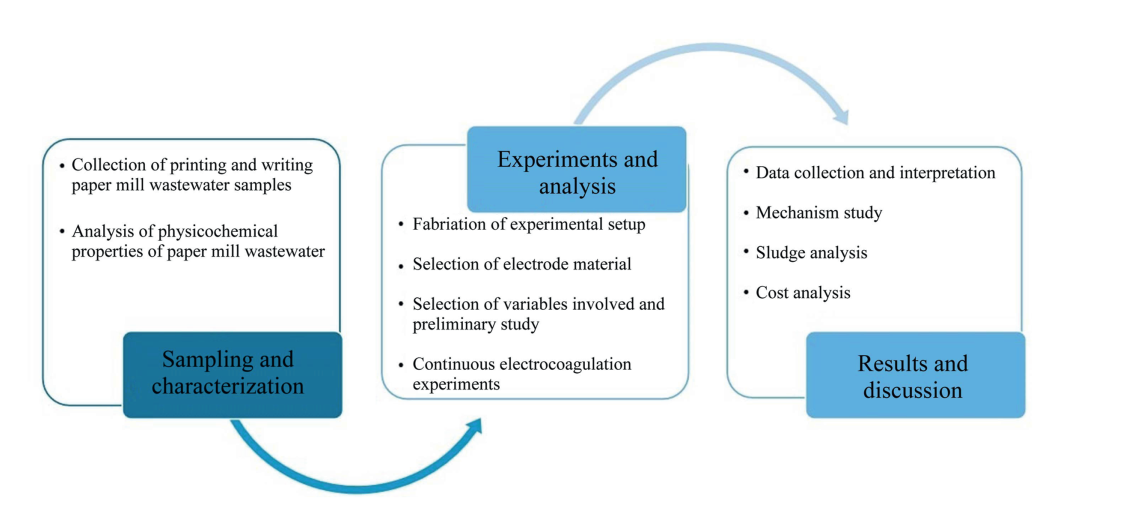
Figures(1)


 DownLoad: