
ISSN :1674-2370
CN :32-1785/TV
| Citation: | Rajaa Zahnoune, Otmane Boudouch, Radouane El Amri, Abdelfattah El Mahbouby, Maryeme Hamdouch, Reda Elkacmi. 2026: Synergistic electrocoagulation in a self-induced airlift reactor: A leap towards energy-efficient and sustainable tannery wastewater remediation. Water Science and Engineering, 19(2): 198-210. doi: 10.1016/j.wse.2026.02.002

|

| [1] |
Al-Qodah, Z., Al-Shannag, M., Al-Degs, Y., Al-Rimawi, F., Al-Qudah, N., 2025a. Performance of continuous electrocoagulation processes (CEPs) as an efficient approach for the treatment of industrial organic pollutants: A comprehensive review. Water 17(15), 2351. https://doi.org/10.3390/w17152351.
|
| [2] |
Al-Qodah, Z., Al-Shannag, M., Al-Degs, Y., Al-Qudah, N., 2025b. Continuous electrocoagulation processes for industrial inorganic pollutants removal: A critical review of performance and applications. Water 17(17), 2639. https://doi.org/10.3390/w17172639.
|
| [3] |
American Public Health Association (APHA), 2017. Standard Methods for the Examination of Water and Wastewater, 23rd Edition. APHA, Washington, DC. https://doi.org/10.2105/SMWW.2882.001.
|
| [4] |
Apaydin, O., Kurt, U., Gonullu, M.T., 2009. An investigation on the treatment of tannery wastewater by electrocoagulation. Global NEST Journal 11(4), 546-555. https://doi.org/10.30955/gnj.000547.
|
| [5] |
Asaithambi, P., Yesuf, M.B., Govindarajan, R., Selvakumar, P., Niju, S., Pandiyarajan, T., Alemayehu, E., 2023. Industrial wastewater treatment using batch recirculation electrocoagulation (BRE) process: Studies on operating parameters. Sustainable Chemistry and Environment 2, 100014. https://doi.org/10.1016/j.scmr.2023.100014.
|
| [6] |
Bingol, Z., Irdemez, S., Yildiz, Y., Demircioglu, N., 2023. Organic and inorganic matter removal from tannery wastewater using the electrocoagulation process. International Journal of Environmental Science and Technology 20, 2171-2180. https://doi.org/10.1007/s13762-022-04144-5.
|
| [7] |
Chang, Z., Long, G., Zhou, J.L., Ma, C., 2020. Valorization of sewage sludge in the fabrication of construction and building materials: A review. Resources, Conservation and Recycling 154, 104606. https://doi.org/10.1016/j.resconrec.2019.104606.
|
| [8] |
Choudhary, V., Goyal, H., Varma, A.K., Shankar, R., Chakma, S., Malviya, P., Thakur, L.S., 2024. Life cycle assessment (LCA) of the lead, chromium, and cadmium removal from water through electrocoagulation. Materials Today: Proceedings 111, 8-14. https://doi.org/10.1016/j.matpr.2023.08.297.
|
| [9] |
Durai, G., Rajasimman, M., 2011. Biological treatment of tannery wastewater: A review. Journal of Environmental Science and Technology 4(1), 1-17. https://doi.org/10.3923/jest.2011.1.17.
|
| [10] |
Elkacmi, R., Bennajah, M., 2019. Advanced oxidation technologies for the treatment and detoxification of olive mill wastewater: A general review. Journal of Water Reuse and Desalination 9(4), 463-505. https://doi.org/10.2166/wrd.2019.033.
|
| [11] |
Elkacmi, R., Boudouch, O., Hasib, A., Bouzaid, M., Bennajah, M., 2020. Photovoltaic electrocoagulation treatment of olive mill wastewater using an external-loop airlift reactor. Sustainable Chemistry and Pharmacy 17, 100274. https://doi.org/10.1016/j.scp.2020.100274.
|
| [12] |
Environmental Protection Agency (EPA), 1992. Method 7196A: Chromium, hexavalent (colorimetric). In: Test Methods for Evaluating Solid Waste, Physical/Chemical Methods (SW-846), 3rd Edition, Update III. EPA Publication No. SW-846. EPA, Washington DC.
|
| [13] |
Gokkus, O., Brillas, E., Sires, I., 2024. Sequential use of a continuous-flow electrocoagulation reactor and a (photo)electro-Fenton recirculation system for the treatment of Acid Brown 14 diazo dye. Science of The Total Environment 912, 169143. https://doi.org/10.1016/j.scitotenv.2023.169143.
|
| [14] |
Goyal, H., Mondal, P., 2022. Life cycle assessment (LCA) of arsenic and fluoride removal from groundwater through adsorption and electrocoagulation: A comparative study. Chemosphere 304, 135243. https://doi.org/10.1016/j.chemosphere.2022.135243.
|
| [15] |
International Organization for Standardization (ISO), 2006a. ISO 14040:2006. Environmental Management - Life Cycle Assessment - Principles and Framework. ISO, Geneva. https://doi.org/10.3403/01139131.
|
| [16] |
International Organization for Standardization (ISO), 2006b. ISO 14044:2006. Environmental Management - Life Cycle Assessment - Requirements and Guidelines. ISO, Geneva. https://doi.org/10.3403/30290345.
|
| [17] |
Juel, M.A.I., Mizan, A., Ahmed, T., 2017. Sustainable use of tannery sludge in brick manufacturing in Bangladesh. Waste Management 60, 259-269. https://doi.org/10.1016/j.wasman.2016.12.041.
|
| [18] |
Kobya, M., Gengec, E., Demirbas, E., 2015. Operating parameters and cost assessments of a real dyehouse wastewater effluent treated by a continuous electrocoagulation process. Chemical Engineering and Processing: Process Intensification 91, 87-100. https://doi.org/10.1016/j.cep.2015.03.012.
|
| [19] |
Lofrano, G., Meric, S., Zengin, G.E., Orhon, D., 2013. Chemical and biological treatment technologies for leather tannery chemicals and wastewaters: A review. Science of The Total Environment 461-462, 265-281. https://doi.org/10.1016/j.scitotenv.2013.05.004.
|
| [20] |
Mollah, M.Y.A., Schennach, R., Parga, J.R., Cocke, D.L., 2004. Electrocoagulation (EC): Science and applications. Journal of Hazardous Materials 84(1), 29-41. https://doi.org/10.1016/S0304-3894(01)00276-5.
|
| [21] |
Nath, S., 2024. Electrochemical wastewater treatment technologies through life cycle assessment: A review. ChemBioEng Reviews 11(4), e202400016. https://doi.org/10.1002/cben.202400016.
|
| [22] |
Nidheesh, P.V., Gokkus, O., 2023. Aerated iron electrocoagulation process as an emerging treatment method for natural water and wastewater. Separation Science and Technology 58(11), 2041-2063. https://doi.org/10.1080/01496395.2023.2227913.
|
| [23] |
Patel, P., Gupta, S., Mondal, P., 2023. Life cycle assessment (LCA) of greywater treatment using ZnCl2 impregnated activated carbon and electrocoagulation processes: A comparative study. Industrial & Engineering Chemistry Research 62(7), 3259-3270. https://doi.org/10.1021/acs.iecr.2c03353.
|
| [24] |
Rajaniemi, K., Tuomikoski, S., Lassi, U., 2021. Electrocoagulation sludge valorization-A review. Resources 10(12), 127. https://doi.org/10.3390/resources10120127.
|
| [25] |
Sivaram, N.M., Barik, D., 2019. Chapter 5 - Toxic waste from leather industries. In: Barik, D. (Ed.), Energy from Toxic Organic Waste for Heat and Power Generation. Woodhead Publishing, Duxford, pp. 55-67. https://doi.org/10.1016/B978-0-08-102528-4.00005-5.
|
| [26] |
Valdiviezo-Gonzales, L., Mancco, F.A., Cartolin, A.P., Molina, J.M., Torres, R.J.C., Quispe, P.R., 2023. Kinetic study of electrocoagulation of tannery wastewater. Chemical Engineering Transactions 98, 69-74. https://doi.org/10.3303/CET2398012.
|
| [27] |
Villalobos-Lara, A.D., Perez, T., Uribe, A.R., Alfaro-Ayala, J.A., Ramirez-Minguela, J.J., 2021. Electrocoagulation treatment of industrial tannery wastewater employing a modified rotating cylinder electrode reactor. Journal of Environmental Chemical Engineering 9(4), 105283. https://doi.org/10.1016/j.jece.2021.105283.
|
| [28] |
Zahnoune, R., Boudouch, O., Elamri, R., El-ghozlani, M., Kamil, N., Elkacmi, R., 2025. Optimized electrocoagulation and kinetic study for continuous treatment of fresh landfill leachate in an external-loop airlift reactor. Chemical Engineering Science 317, 122115. https://doi.org/10.1016/j.ces.2025.122115.
|
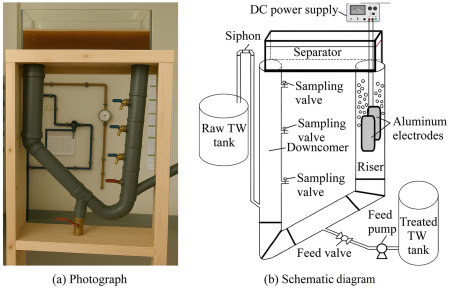
Figures(1)


 DownLoad: