
ISSN :1674-2370
CN :32-1785/TV
| Citation: | Alex J. Garzón-Orduña, Oscar E. Coronado-Hernández, Alfonso Arrieta-Pastrana, Helena M. Ramos, Modesto Pérez-Sánchez. 2026: Coupled rigid water column–global gradient formulation for leakage assessment in looped water distribution networks. Water Science and Engineering, 19(3): 455-468. doi: 10.1016/j.wse.2026.05.001

|

| [1] |
Ahmed, I., 1997. Application of the Gradient Method for the Analysis of Unsteady Flow in Water Networks. The University of Arizona, Tucson. https://repository.arizona.edu/handle/10150/192098.
|
| [2] |
Alegre, H., Coelho, S.T., 2013. Infrastructure Asset Management of Urban Water Systems. Australian National Audit Office, Canberra.
|
| [3] |
Alegre, H., Melo Baptista, J., Cabrera, E., Duarte, P., Cubillos, F., Hirner, W., Parena, R., 2016. Performance Indicators for Water Supply Services (2nd Edition). IWA Publishing, Lone.
|
| [4] |
American Water Works Association, 2024. M36 - Water Audits and Loss Control Programs (5th Edition). American Water Works Association, Denver.
|
| [5] |
Anderson, C.N., Bosserman Ii, B.E., Morris, C.D., Cadrecha, C., Lescovich, J.E., Taylor, H.W., Vuncannon, J., 2008. Chapter 5 - Valves. In: Jones, G.M., Sanks, R.L., Tchobanoglous, G., Bosserman II, B.E. (Eds.), Pumping Station Design (Third Edition). Butterworth-Heinemann, Oxford. https://doi.org/10.1016/B978-185617513-5.50012-3.
|
| [6] |
Axworthy, D.H., 1997. Water Distribution Network Modelling: From Steady State to Water Hammer. The University of Toronto, Toronto. http://www.collectionscanada.ca/obj/s4/f2/dsk2/ftp02/NQ27600.pdf http://hdl.handle.net/1807/10579.
|
| [7] |
Axworthy, D.H., Karney, B.W., 2000. Valve closure in graph-theoretical models for slow transient network analysis. J. Hydraul. Eng. 126(4), 304-309. https://doi.org/10.1061/(ASCE)0733-9429(2000)126:4(304).
|
| [8] |
Bohorquez, A.J.M., Saldarriaga, V.J.G., Iglesias R.P.L., 2014. Optimization of Valve Operation to Minimise Transient Flow Effects in Drinking Water Distribution Networks: Application to the Trunk Network of Bogota D.C. Universidad de los Andes, Bogota (in Spanish).es.
|
| [9] |
Capponi, C., Veritti, L., Tirello, L., Rubin, A., Brunone, B., Meniconi, S., 2025. Swinging pressure reducing valve in a real water distribution network: Where is the catch? Physics of Fluids 37(7), 075202. https://doi.org/10.1063/5.0272761.
|
| [10] |
Chaiworapuek, W., Champagne, J.Y., El Hajem, M., Kittichaikan, C., 2010. An investigation of the water flow past the butterfly valve. AIP Conference Proceedings 1225, 562-575. https://doi.org/10.1063/1.3464904.
|
| [11] |
Chaudhry, M.H., 2014. Applied Hydraulic Transients (Third Edition). Springer, New York. https://doi.org/10.1007/978-1-4614-8538-4.
|
| [12] |
Coronado-Hernandez, O.E., Perez-Sanchez, M., Arrieta-Pastrana, A., Fuertes-Miquel, V.S., Coronado-Hernandez, J.R., Quinones-Bolanos, E., Ramos, H.M., 2024. Dynamic effects of a regulating valve in the assessment of water leakages in single pipelines. Water Resources Management 38(8), 2889-2903. https://doi.org/10.1007/s11269-024-03797-w.
|
| [13] |
Covas, D., Ramos, H., 2010. Case studies of leak detection and location in water pipe systems by inverse transient analysis. J. Water Resour. Plann. Manag. 136(2), 248-257. https://doi.org/10.1061/(ASCE)0733-9496(2010)136:2(248).
|
| [14] |
Cross, H., 1936. Analysis of Flow in Networks of Conduits or Conductors. Engineering Experiment Station. University of Illinois, Urbana.
|
| [15] |
Ferrarese, G., Malavasi, S., 2022. Performances of pressure reducing valves in variable demand conditions: Experimental analysis and new performance parameters. Water Resources Management 36(8), 2639-2652. https://doi.org/10.1007/s11269-022-03166-5.
|
| [16] |
Fuertes-Miquel, V.S., Arrieta-Pastrana, A., Coronado-Hernandez, O.E., 2024a. Analyzing water leakages in parallel pipe systems with rapid regulating valve maneuvers. Water 16(7), 926. https://doi.org/10.3390/w16070926.
|
| [17] |
Fuertes-Miquel, V.S., Coronado-Hernandez, O.E., Arrieta-Pastrana, A., 2024b. An analysis of water leakages in series pipelines using the rigid column model. Fluids 9(9), 201. https://doi.org/10.3390/fluids9090201.
|
| [18] |
Giustolisi, O., Todini, E., 2009. Pipe hydraulic resistance correction in WDN analysis. Urban Water Journal 6(1), 39-52. https://doi.org/10.1080/15730620802541623.
|
| [19] |
Giustolisi, O., Laucelli, D., Berardi, L., Savic, D.A., 2012. Computationally efficient modeling method for large water network analysis. Journal of Hydraulic Engineering 138(4), 313-326. https://doi.org/10.1061/(asce)hy.1943-7900.0000517.
|
| [20] |
Giustolisi, O., Walski, T.M., 2012. Demand components in water distribution network analysis. Journal of Water Resources Planning and Management 138(4), 356-367. https://doi.org/10.1061/(asce)wr.1943-5452.0000187.
|
| [21] |
Giustolisi, O., Mazzolani, G., Berardi, L., Laucelli, D.B., 2024. From advanced hydraulic modelling to performance indicator for the efficiency of investments in leakage management of pressurized water systems. Water Research 258, 121765. https://doi.org/10.1016/j.watres.2024.121765.
|
| [22] |
Greyvenstein, B., van Zyl, J.E., 2007. An experimental investigation into the pressure-leakage relationship of some failed water pipes. Journal of Water Supply 56(2), 117-124. https://doi.org/10.2166/aqua.2007.065.
|
| [23] |
Hedaiaty Marzouny, N., Jalili Ghazizadeh, M., Moslehi, I., Komeily, M., 2024. Application of pressure reducing and throttle control valves for optimal pressure management in water distribution networks. Urban Water Journal 21(1), 65-79. https://doi.org/10.1080/1573062X.2023.2263424.
|
| [24] |
Holloway, M., 1985. Dynamic Pipe Network Computer Model (Surge Analysis, Transient, Unsteady flow). Washington State University, Pullman.
|
| [25] |
Iglesias Rey, P.L., Garcia-Serra Garcia, J., Izquierdo Sebastian, J., 2001. General Model for the Analysis of Pressurised Hydraulic Networks under Transient Conditions. Universitat Politecnica de Valencia, Valencia (in Spanish).es.
|
| [26] |
Islam, M.R., Chaudhry, M.H., 1998. Modeling of constituent transport in unsteady flows in pipe networks. J. Hydraul. Eng. 124(11), 1115-1124. https://doi.org/10.1061/(ASCE)0733-9429(1998)124:11(1115).
|
| [27] |
Jara-Arriagada, C., Stoianov, I., 2021. Pipe breaks and estimating the impact of pressure control in water supply networks. Reliability Engineering and System Safety 210, 1075525. https://doi.org/10.1016/j.ress.2021.107525.
|
| [28] |
Kang, J., Park, Y. J., Lee, J., Wang, S.H., Eom, D.S., 2018. Novel leakage detection by ensemble CNN-SVM and graph-based localization in water distribution systems. IEEE Transactions on Industrial Electronics 65(5), 4279-4289. https://doi.org/10.1109/TIE.2017.2764861.
|
| [29] |
Karney, B., Nault, J., 2019. Steps toward redeeming the physical and practical insights of the “rigid column” approach to transient analysis. In: Proceedings of the 38th IAHR World Congress. IAHR, Panama, pp. 3331-3338. https://doi.org/10.3850/38WC092019-1743.
|
| [30] |
Kosucu, M.M., Albay, E., Demirel, M.C., 2022. Extending EPANET hydraulic solver capacity with rigid water column global gradient algorithm. Journal of Hydro-environment Research 42, 31-43. https://doi.org/10.1016/j.jher.2022.04.002.
|
| [31] |
Kosucu, M.M., Demirel, M.C., 2022. Smart pressure management extension for EPANET: Source code enhancement with a dynamic pressure reducing valve model. Journal of Hydroinformatics 24(3), 642-658. https://doi.org/10.2166/hydro.2022.172.
|
| [32] |
Kosucu, M.M., Demirel, M.C., 2024. Cost efficiency assessment of four pressure management methods in water distribution systems. Journal of Water Resources Planning and Management 150(3), 05023022. https://doi.org/10.1061/jwrmd5.wreng-5984.tr.
|
| [33] |
Lambert, A.O., 2001. International report: Water losses management and techniques. Water Supply 2(4), 1-20. https://doi.org/10.2166/ws.2002.0115.
|
| [34] |
Liemberger, R., Wyatt, A., 2019. Quantifying the global non-revenue water problem. Water Supply 19(3), 831-837. https://doi.org/10.2166/ws.2018.129.
|
| [35] |
Moreno-Aldana, E.A., Frota, M.N., Aguilar, I.I., Germano, S.B., 2025. Experimental and simulation analysis of the flow coefficient of solenoid valves: The controversy between research and manufacturer technical specifications. Flow Measurement and Instrumentation 107, 103061. https://doi.org/10.1016/j.flowmeasinst.2025.103061.
|
| [36] |
Nault, J.D., Karney, B.W., 2016a. Adaptive hybrid formulation for simulating incompressible pipe network hydraulics. Journal of Hydraulic Engineering 142(11), 04016050. https://doi.org/10.1061/(asce)hy.1943-7900.0001195.
|
| [37] |
Nault, J.D., Karney, B.W., 2016b. Improved rigid water column formulation for simulating slow transients and controlled operations. Journal of Hydraulic Engineering 142(9), 04016025. https://doi.org/10.1061/(asce)hy.1943-7900.0001145.
|
| [38] |
Office of Water Services (OFWAT), 2023. Water Company Performance Report. OFWAT, Birmingham.
|
| [39] |
Onizuka, K., 1986. System dynamics approach to pipe network analysis. J. Hydraul. Eng. 112(8), 728-749. https://doi.org/10.1061/(ASCE)0733-9429(1986)112:8(728).
|
| [40] |
Prescott, S.L., Ulanicki, B., 2003. Dynamic modeling of pressure reducing valves. J. Hydraul. Eng. 129(10), 804-812. https://doi.org/10.1061/(asce)0733-9429(2003)129:10(804).
|
| [41] |
Qi, Z., Zheng, F., Guo, D., Zhang, T., Shao, Y., Yu, T., Zhang, K., Maier, H.R., 2018. A comprehensive framework to evaluate hydraulic and water quality impacts of pipe breaks on water distribution systems. Water Resources Research 54(10), 8174-8195. https://doi.org/10.1029/2018WR022736.
|
| [42] |
Ramos, H.M., Morani, M.C., Carravetta, A., Fecarrotta, O., Adeyeye, K., Lopez-Jimenez, P.A., Perez-Sanchez, M., 2022. New challenges towards smart systems’ efficiency by digital twin in water distribution networks. Water 14(8), 1304. https://doi.org/10.3390/w14081304.
|
| [43] |
Romero-Ben, L., Alves, D., Blesa, J., Cembrano, G., Puig, V., Duviella, E., 2023. Leak detection and localization in water distribution networks: Review and perspective. Annual Reviews in Control 55, 392-419. https://doi.org/10.1016/j.arcontrol.2023.03.012.
|
| [44] |
Rossman, L.A., Woo, H., Tryby, M., Shang, F., Janke, R., 2021. EPANET 2.2 User Manual. US Environmental Protection Agency, Washington DC.
|
| [45] |
Shimada, M., 1989. Graph-theoretical model for slow transient analysis of pipe networks. J. Hydraul. Eng. 115(9), 1165-1183. https://doi.org/10.1061/(ASCE)0733-9429(1989)115:91(165).
|
| [46] |
Shimada, M., 1992. State-space analysis and control of slow transients in pipes. J. Hydraul. Eng. 118(9), 1287-1304. https://doi.org/10.1061/(ASCE)0733-9429(1992)118:9(1287).
|
| [47] |
Tanyanyiwa, C.T., van Zyl, J.E., 2022. A novel device for pressure-based leakage characterisation in water distribution pipes. Urban Water Journal 19(8), 798-811. https://doi.org/10.1080/1573062X.2022.2086886.
|
| [48] |
Taylor, J.E., Bennett, G., Mohammadi, N., 2021. Engineering smarter cities with smart city digital twins. Journal of Management in Engineering 37(6), 02021001. https://doi.org/10.1061/(asce)me.1943-5479.0000974.
|
| [49] |
Thornton, J., Lambert, A., 2005. Progress in practical prediction of pressure: Leakage, pressure: Burst frequency and pressure: Consumption relationships. In: Proceedings of IWA Special Conference Leakage. IWA Publishing, London,.
|
| [50] |
Thornton, J., Sturm, R., Kunkel, G., 2008. Water Loss Control (2nd Edition). McGraw-Hill, Columbus. https://doi.org/10.1036/0071499180.
|
| [51] |
Todini, E., Pilati, S., 1988. A gradient algorithm for the analysis of pipe networks. In: Coulbeck, B., Orr, C. (Eds.), Computer Applications in Water Supply: Vol. 1 − Systems Analysis and Simulation. Research Studies Press, Somerset, pp.1-20.
|
| [52] |
Todini, E., 2011. Extending the global gradient algorithm to unsteady flow extended period simulations of water distribution systems. Journal of Hydroinformatics 13(2), 167-180. https://doi.org/10.2166/hydro.2010.164.
|
| [53] |
Todini, E., Rossman, L.A., 2013. Unified framework for deriving simultaneous equation algorithms for water distribution networks. Journal of Hydraulic Engineering 139(5), 511-526. https://doi.org/10.1061/(asce)hy.1943-7900.0000703.
|
| [54] |
Twyman, J., 2018. Water hammer in a pipe network due to a fast valve closure. Revista Ingenieria de Construccion 33(2), 193-200.
|
| [55] |
Ulanicki, B., Skworcow, P., 2014. Why PRVs tends to oscillate at low flows. Procedia Engineering 89, 378-385. https://doi.org/10.1016/j.proeng.2014.11.202.
|
| [56] |
van Zyl, K., Ghasemi, Z., 2024. Modelling the Impact of Pressure Management on Pipe Burst Rates. The University of Auckland, Auckland.
|
| [57] |
Vicente, D.J., Garrote, L., Sanchez, R., Santillan, D., 2016. Pressure management in water distribution systems: Current status, proposals, and future trends. Journal of Water Resources Planning and Management 142(2), 04015061. https://doi.org/10.1061/(asce)wr.1943-5452.0000589.
|
| [58] |
Vrachimis, S.G., Eliades, D.G., Polycarpou, M.M., 2018. Leak detection in water distribution systems using hydraulic interval state estimation. In: Proceedings of the 2018 IEEE Conference on Control Technology and Applications. IEEE, Copenhagen, pp. 565-570. https://doi.org/10.1109/CCTA.2018.8511516.
|
| [59] |
Walski, T.M., Chase, D.V., Savic, D.A., Grayman, W., Beckwith, S., Koelle, E., 2009. Advanced Water Distribution Modeling and M. Bentley Institute Press, Waterbury.
|
| [60] |
Wu, Z.Y., Wang, R.H., Walski, T.M., Yang, S.Y., Bowdler, D., Baggett, C.C., 2007. Efficient pressure dependent demand model for large water distribution system analysis. In: Proceedings of Water Distribution Systems Analysis Symposium 2006. ASCE, Cincinnati. https://doi.org/10.1061/40941(247)39.
|
| [61] |
Zhou, X.M., Wang, Z.K., Zhang, Y.F., 2017. A simple method for high-precision evaluation of valve flow coefficient by computational fluid dynamics simulation. Advances in Mechanical Engineering 9(7), 1-7. https://doi.org/10.1177/1687814017713702.
|
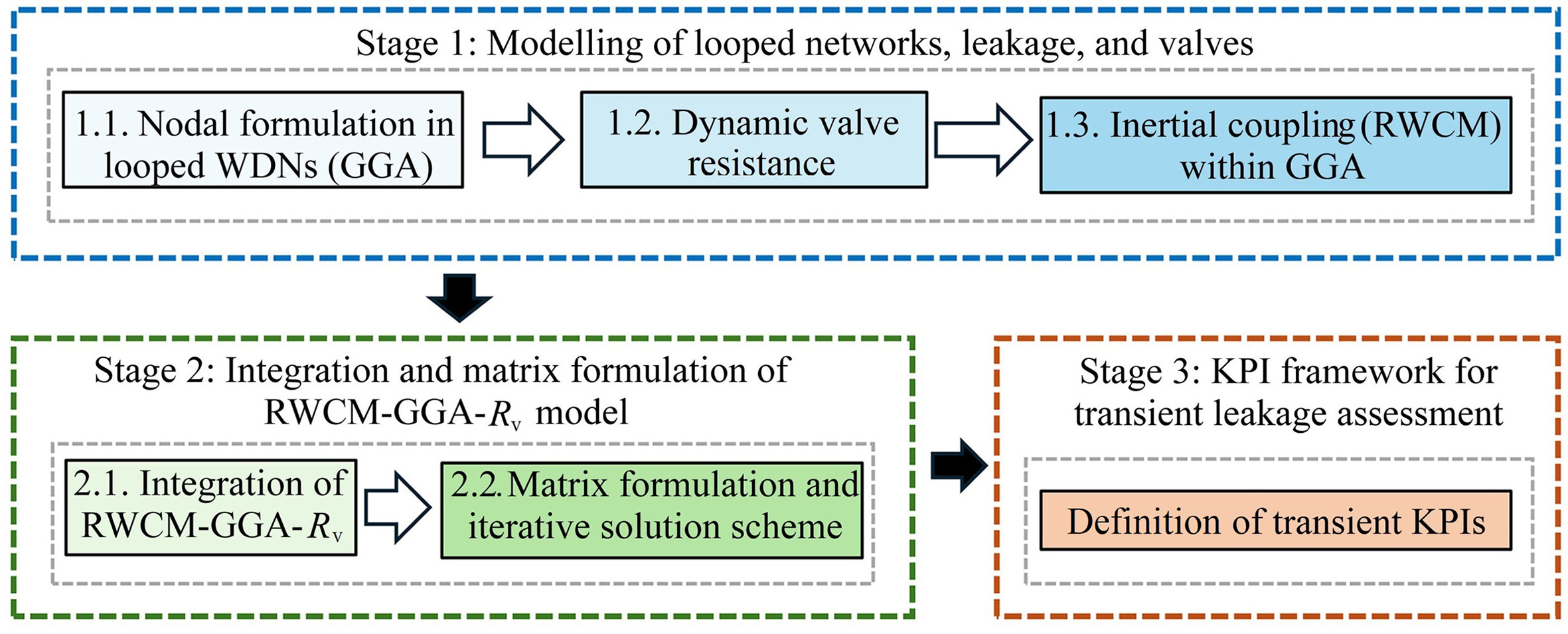
Figures(1)


 DownLoad: